

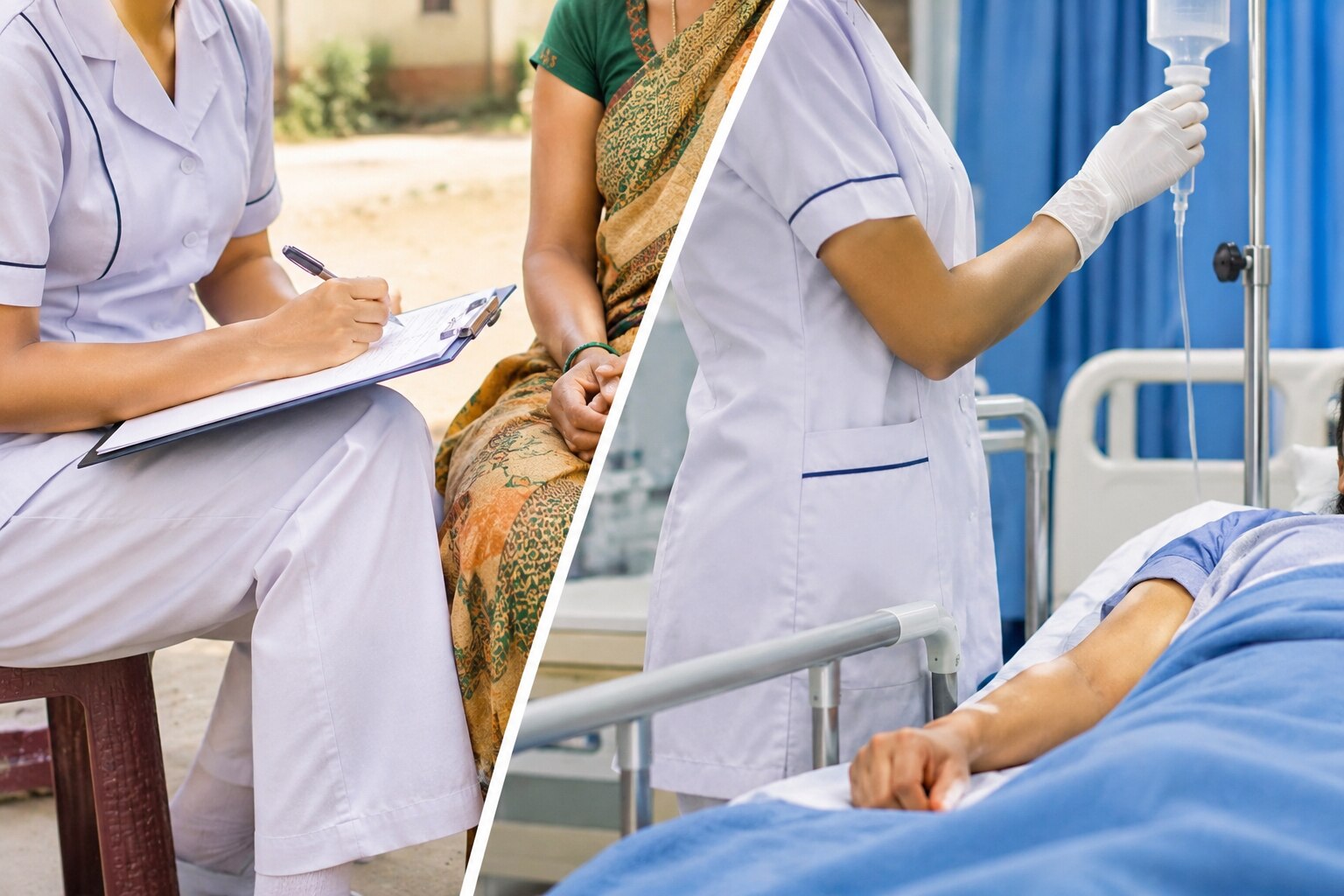
A G.N.M. student prepares for more than ward-based bedside care: the course covers household health work, public-health services, maternity care and several hospital departments. By the end, readers will be able to distinguish these responsibilities, understand the limits of student practice and assess whether a G.N.M. programme offers credible training and progression.
Key takeaways
- G.N.M. nurses work in homes, schools, outreach camps and primary health centres.
- Clinical training covers ward care, maternity, emergency response and community nursing.
- Students must practise assessment, procedures, reporting and patient documentation.
- Check clinical placements, supervision, skills records and registration guidance before enrolling.
Where G.N.M. nurses work in the community
Community-health nursing involves preventing illness, finding health problems early and supporting families where they live, study and work—not only treating patients in wards. G.N.M. community nursing places students in a primary health centre, sub-centre, households, outreach camps and school health services.
Typical responsibilities include:
- Visiting homes to assess living conditions, explain hygiene and nutrition, identify danger signs and refer patients.
- Supporting antenatal and postnatal follow-up, breastfeeding guidance, newborn observation and family-welfare counselling.
- Assisting with immunisation sessions, checking records and explaining follow-up doses to caregivers.
- Recording symptoms, contacts and referrals during communicable-disease surveillance.
- Conducting health education on sanitation, safe water, menstrual health, diabetes, tuberculosis and other preventable conditions.
- Helping organise screening, health talks and referrals during village and school outreach activities.
At a sub-centre or primary health centre, the nurse may assess vital signs, maintain registers, dress wounds, provide prescribed medicines under authorised supervision and coordinate referrals. A home visit also requires communication, privacy and practical advice suited to the family’s resources; it is not a shortened hospital round.
The difference is the goal: hospital nursing focuses on stabilising and treating an individual patient, while community nursing follows people across households and populations to prevent disease, improve maternal and child health and ensure continuing care after referral or discharge.
From medical-surgical wards to maternity and emergency care
A G.N.M. student is prepared for hospital nursing across adult wards, maternity, paediatrics, mental-health units and emergency care—not only routine bedside tasks. Medical-surgical nursing and midwifery training extend from assessment and treatment support to maternal-newborn care.
| Department | Typical G.N.M. responsibilities | What clinical exposure should show |
|---|---|---|
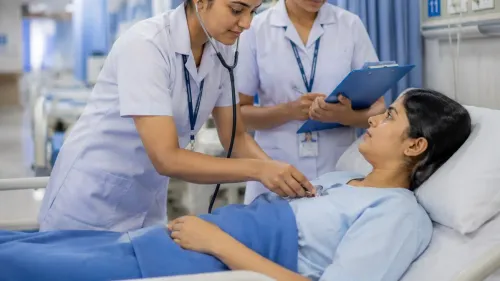
| Medical-surgical ward | Take vital signs; assess pain; administer medicines under supervision; provide wound and catheter care; collect specimens; maintain nursing notes; report deterioration | Scheduled ward rotations, varied medical and surgical cases, and signed procedure records |
| Maternity and labour room | Provide antenatal, intranatal and postnatal care; monitor mother and foetus; support normal labour; provide newborn care; identify complications and arrange referral | A functioning labour room, supervised deliveries and a documented maternity caseload |
| Paediatrics | Measure temperature, pulse, respiration and weight; support feeding; administer prescribed treatment; observe illness changes | Direct care of infants and children, not only classroom demonstrations |
| Emergency department | Perform rapid observations; assist triage, first aid, oxygen therapy, wound care and safe transfer; hand over urgent findings | Supervised exposure to genuine emergencies and shift-based handover |
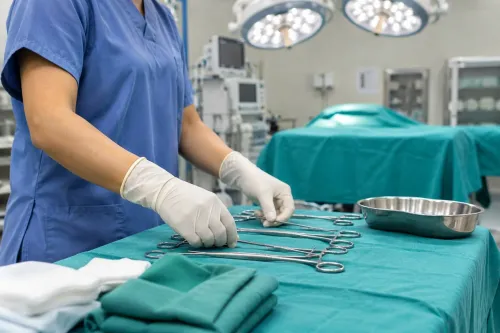
| Operation theatre | Prepare patients, equipment and records; follow surgical asepsis; assist with positioning, counts and recovery-room observation | Repeated theatre postings with infection-control supervision |
| Psychiatric unit | Use therapeutic communication; observe behaviour; maintain safety; document care | Mental-health nursing postings with staff supervision |
These areas rely on accurate documentation, patient identification, medicine checks, infection-control precautions and escalation of abnormal findings. Ask for attendance sheets, rotation schedules and supervised-procedure logs; a paper hospital tie-up does not prove access to patients.
What students actually learn, perform and document
A G.N.M. course duration is normally three years, including a supervised internship, but preparation extends beyond lectures. Classroom study covers medical-surgical, child-health, mental-health and community-health nursing, nutrition, midwifery, infection prevention, nursing education and research. Students learn why a procedure is done before practising how to do it.
The skills lab turns theory into supervised practice on mannequins and equipment. Students rehearse these patient-care steps before performing them with assigned patients:
- Check identity, history, allergies and vital signs, then report abnormal findings.
- Administer medicines under supervision, following the prescription, correct patient, drug, dose, route and time.
- Perform wound dressing, catheter care, specimen collection and basic infection-control procedures.
- Assist with mobility, hygiene, nutrition, antenatal care, newborn care and emergency first response.
- Record assessments, medicines, procedures, intake and output, patient responses and follow-up in nursing notes.
- Give a structured handover so the next nurse knows the patient’s condition, treatment and pending care.
During clinical postings, students rotate through wards and community settings under registered nurses and clinical teachers. They learn to manage several patients, communicate with families and recognise deterioration, while shift work, night-duty exposure, practical examinations and frequent documentation test stamina and accuracy.
Attendance and clinical-duty rules matter: missed supervised practice cannot be replaced by classroom attendance alone.
Registration, role boundaries and the next qualification
Passing the G.N.M. course does not by itself authorise practice everywhere in India. After successful completion, apply for State Nursing Council registration, generally as a Registered Nurse and Registered Midwife (R.N./R.M.), under that council’s rules. Employers also set their own eligibility conditions.
The practical differences are clearer in this comparison:
| Role | Typical scope | Boundary |
|---|---|---|
| ANM | Sub-centre and community work, immunisation support, antenatal care, health education and basic maternal-child services | Narrower training; not equivalent to G.N.M. hospital preparation |
| G.N.M. nurse | Staff-nurse or nursing-officer duties in wards, emergency units, maternity services, primary-health facilities and long-term care | Must work within registration, employer policy and clinical competence |
| B.Sc. Nursing graduate | Registered nursing practice plus broader degree-level preparation for roles and study with higher academic requirements | B.Sc. Nursing versus GNM: recruitment, promotion and teaching eligibility can differ |
| Home-care helper | Companionship, bathing, feeding, mobility and household support | Not a nurse; cannot replace registered nursing assessment, clinical documentation or authorised treatment |
A G.N.M. nurse may administer prescribed medicines, monitor patients, provide wound and catheter care, support childbirth, educate families and report deterioration according to workplace protocols. The ANM versus GNM distinction matters when a vacancy specifies ward, emergency or hospital-based duties.
After registration, check each recruitment notice before applying. A common next step is Post Basic B.Sc. Nursing, but admission rules can require 10+2 subjects, current registration, work experience, an entrance test or a limited number of seats.
How to test whether a G.N.M. college delivers the promised scope
Do not accept “INC approved” as proof that your qualification will be valid. Before paying fees, obtain documents and answers that can be checked independently.
| Check | Ask for | Warning sign |
|---|---|---|
| G.N.M. eligibility | Current admission rules, including schooling, age and medical-fitness requirements | Staff give verbal rules that differ from the written prospectus |
| Nursing college recognition | Current State Nursing Council status, examining authority for G.N.M. examinations and affiliating-body details | The college shows only an “INC approved” claim |
| Clinical-affiliation quality | Written hospital agreement, rotation timetable, attendance records and named supervisors | A “tie-up” has no schedule or student attendance system |
| Hospital patient load | Ward-wise case exposure in medical-surgical nursing, paediatrics, maternity, psychiatry and emergency care | Students observe but rarely perform supervised procedures |
| Workload and facilities | Attendance, leave and night-duty policies; skills lab, mannequins, simulation equipment and documentation practice | The advertised course duration hides frequent cancelled postings |
Ask how many students share each clinical placement and who signs off medicines, wound care, catheter care, specimen collection and nursing notes. Scheduled community visits should include antenatal follow-up, immunisation support and health education, not only classroom discussion.
The course combines lectures, practical examinations, shift duties and patient documentation, so inspect the timetable before enrolling. At Amar Professional College of Nursing 08048059238, use the same document-and-evidence checklist rather than relying on the college name or brochure.
Related product
 | ₹55000 Age: for entrance shall be 17 to 35 years as on 1st September of the year of Admission. View product → |
Frequently asked questions
Where do G.N.M. nurses work in community health?
They work through primary health centres, sub-centres, household visits, outreach camps and school health services.
What hospital areas does G.N.M. training cover?
Training covers medical-surgical wards, maternity services and emergency care alongside community nursing.
What do G.N.M. students learn and document?
Students learn patient assessment and nursing procedures, then document observations, care provided, reports and referrals.
What should you check before choosing a G.N.M. college?
Check its hospital and community placements, clinical supervision, practical skills records and guidance on registration and progression.