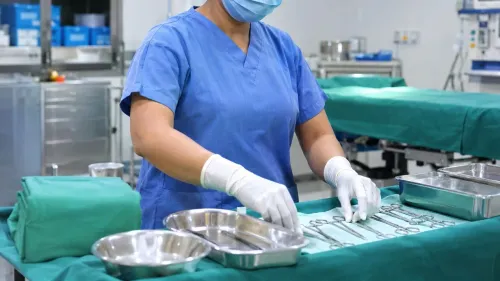



An OT attendant must prepare a safe operating room, support patient movement, protect the sterile field and complete post-operative turnover without taking over decisions reserved for nurses, surgeons or anaesthesia staff. By the end, you will know what training should demonstrate, how infection-control failures are handled and whether an OT attendant course matches your career goal.
Key takeaways
- An OT attendant supports surgery but does not make clinical decisions or provide independent nursing care.
- Check the room, equipment, supplies and safety records before the patient enters.
- Follow hand antisepsis and sterile-storage procedures to protect instruments and patients.
- Compare course recognition, practical assessments and documented placement evidence before enrolling.
What an OT Attendant Does Before, During and After Surgery
An OT attendant supports the surgical team from room preparation through turnover, but does not make clinical decisions or provide independent nursing care.
1. Before the patient arrives, duties include checking room cleanliness, operating-table movement, lights, suction, oxygen, cautery, emergency equipment, sterile packs, instruments, consumables, implants and specimen containers. Report missing supplies or faulty equipment before incision. Prepare transfer equipment and complete the required records.
2. During patient transfer, follow the team’s instructions and provide patient positioning support without independently deciding the position. Assist with safe movement, equipment connection, supply opening and traffic control while protecting the sterile field. Hand hygiene remains necessary before patient contact and after glove removal; gloves do not replace it.
Support the three WHO Surgical Safety Checklist pauses, but the responsible clinical team must confirm the answers.
3. During and after surgery, help with sponge, needle and instrument counts only under local policy and supervision. Announce an unexplained discrepancy immediately; the patient must not leave the operating room until the escalation procedure resolves it.
Complete specimen handling and transport records, label containers as directed, segregate waste, send specimens through the approved route, clean and disinfect assigned surfaces, restock supplies and prepare the room for the next case.
The role stops at delegated support. An attendant must not assess a patient independently, administer medicines or anaesthesia, perform surgery, make antibiotic or infection-treatment decisions, or replace a scrub nurse, circulating nurse or registered nurse.
An OT attendant course does not qualify someone as an ANM, GNM or registered nurse; those are separate programmes with separate registration requirements.
The Pre-Patient OT Check: Room, Equipment, Supplies and Safety Records
Before the patient enters, complete operation theatre preparation as a documented go/no-go check. A missing item or failed device must be escalated before anaesthesia or incision, not discovered during surgery.
- Inspect room cleanliness, floor, surfaces, waste bins and traffic routes. Remove used materials and confirm that the room is ready for the planned procedure.
- Test the operating table and lights, suction and oxygen checkers, monitors, cautery equipment and other procedure-specific devices. Report leaks, low oxygen supply, damaged cables or failed alarms.
- Confirm instrument availability, intact and correctly labelled sterile packs, consumables, implants where required and specimen containers. Check expiry dates and package seals.
- Locate and verify emergency equipment, including the resuscitation trolley, defibrillator, suction backup and oxygen backup. Record checks according to local policy.
- Before transfer, support the responsible clinical team as it verifies patient identification, consent, procedure and site marking against the records. Familiarity with the patient or operating list is not enough.
- Prepare documentation for the WHO Surgical Safety Checklist. The team confirms its three pauses: before anaesthesia, before skin incision and before the patient leaves the operating room. Support instrument, sponge and needle counts; report any discrepancy immediately.
Keep only the supplies needed for the case inside the room. An OT attendant prepares equipment and records, but does not independently confirm clinical decisions or resolve a count discrepancy; the responsible team must do that before the patient leaves.
Infection Control from Hand Antisepsis to Sterilised Instrument Storage
A blood-stained instrument cannot go straight into an autoclave steriliser. An OT attendant must learn surgical hand antisepsis, hand hygiene before donning and after doffing gloves, and correct donning and doffing gloves and gowns. Mask and eye protection prevent exposure, while surgical asepsis protects the sterile field.
| Stage | Required practice | Failure prevented |
|---|---|---|
| Cleaning | Remove blood and tissue before further processing | Disinfection or sterilisation failure |
| Disinfection | Apply the approved chemical or thermal method to the item’s risk level | Cross-contamination from reusable equipment |
| Decontamination | Contain, label and transport used items safely to processing | Exposure during handling |
| Sterilisation | Use an autoclave, check steriliser indicators and complete load records | Unverified instrument cycles |
| Storage | Keep intact packs in a dry, protected area; reject wet packs, torn packs or punctures | Use of compromised sterile supplies |
- Keep sterile-field boundaries clear: separate sterile and nonsterile supplies, control traffic and door opening, and perform aseptic transfer of supplies without reaching over the field. Report any suspected breach immediately; wiping or rearranging a contaminated item cannot restore sterility.
- Place contaminated instruments in closed, labelled containers for safe transport. Follow biomedical waste segregation, never recap needles, use sharps safety practices, and report a needle-stick injury immediately for first aid and exposure assessment.
- During room turnover, clean high-touch surfaces and equipment, then follow the required disinfection process. Store sterilised instruments by package integrity and handling, not merely by storage age; an unexplained count of sponges, needles or instruments must be announced and escalated before the patient leaves.
How Training Proves Competence—and What the Work Demands
Competence is proven by observed performance, not attendance alone. Classroom learning can test infection-control principles, patient identification, waste segregation, blood exposure reporting and role boundaries. Simulation practice shows whether you can prepare a room, transfer and position a patient safely, handle supplies and respond to a contamination or equipment problem without entering a sterile field.
A supervised OT placement adds real pace and pressure. You learn how room turnover, specimen handling, restocking and communication work during surgery, while a preceptor records return demonstrations and completes observation checklists.
On-the-job induction then confirms that you can follow that hospital’s equipment checks, documentation, emergency routes and checklist compliance rather than relying on classroom habits.
Look for assessment evidence that includes:
- Practical examinations covering theatre preparation, patient transfer, cleaning workflows and safe equipment handling
- Hand-hygiene audits before patient contact, before aseptic tasks, after body-fluid exposure risk and after glove removal
- Equipment checks for suction, oxygen, lights, cautery and emergency supplies
- Sharps disposal and blood exposure response drills, including immediate reporting and institutional follow-up
- Repeated observation until you meet the required standard, not a single signed attendance sheet
The work also demands prolonged standing, lifting and shift work. Ask for the written syllabus, supervised OT placement hours, CSSD hours, competency records and the exact certificate-issuing body. A college’s nursing programmes do not prove that its separate attendant course has adequate placement or recognition.
Choosing the Course: Role Boundaries, Recognition and Placement Evidence
Choose an OT attendant course only if its role boundaries match the vacancy you want. An OT attendant supports preparation, transfer, supplies, delegated counts, cleaning and records; it does not provide a registered nursing degree qualification or authorise independent assessment, medication, anaesthesia or clinical decisions.
| Role | Primary work | Boundary to check |
|---|---|---|
| OT attendant | Theatre setup, turnover and delegated support | Not independent nursing care |
| Scrub nurse | Sterile instruments and field | Requires nursing qualification and training |
| Circulating nurse | Non-sterile coordination and documentation | Not an attendant substitute |
| Sterile processing technician | Cleaning, packaging, sterilisation and traceability | Usually works through CSSD |
| Ward attendant | Basic ward and patient-support tasks | Not theatre-specific |
| Operating-room technician | Title varies by employer and jurisdiction | Confirm the written job description |
For an OT attendant course comparison, request these documents before paying:
- Written syllabus covering infection control, biomedical-waste handling, exposure management and the full instrument-processing chain.
- Course duration, clinical hours, CSSD hours, supervised case exposure and hospital affiliation, with the placement address and supervisor named.
- Assessment method, competency checklists, attendance rules, certificate issuer and placement support policy.
- Written evidence of employer recognition from your target hospital, not a claim that the college’s ANM, GNM or B.Sc. Nursing programmes guarantee recognition.
Amar Professional College of Nursing 08048059238 should be asked the same questions: its separate OT course needs its own certificate and placement evidence, because nursing-course approval does not prove OT training recognition. Confirm nursing career limits before enrolling.
Frequently asked questions
What does an OT attendant do before, during and after surgery?
Before surgery, the attendant prepares the room, equipment and supplies. During surgery, the attendant supports the team within assigned duties. After surgery, the attendant helps with room turnover, waste handling and restocking.
What belongs on a pre-patient OT check?
Check the operating room, lighting, tables, suction, patient-support equipment, sterile supplies, emergency items and required safety records before the patient enters.
How does infection control training cover the operating theatre?
Training covers hand antisepsis, clean and dirty workflow, handling sterile packs, safe waste segregation and storing sterilised instruments without compromising their packaging.
How can you compare OT attendant courses?
Check the course syllabus, practical competence assessments, certificate recognition, role boundaries and written evidence of clinical placement before enrolling.