

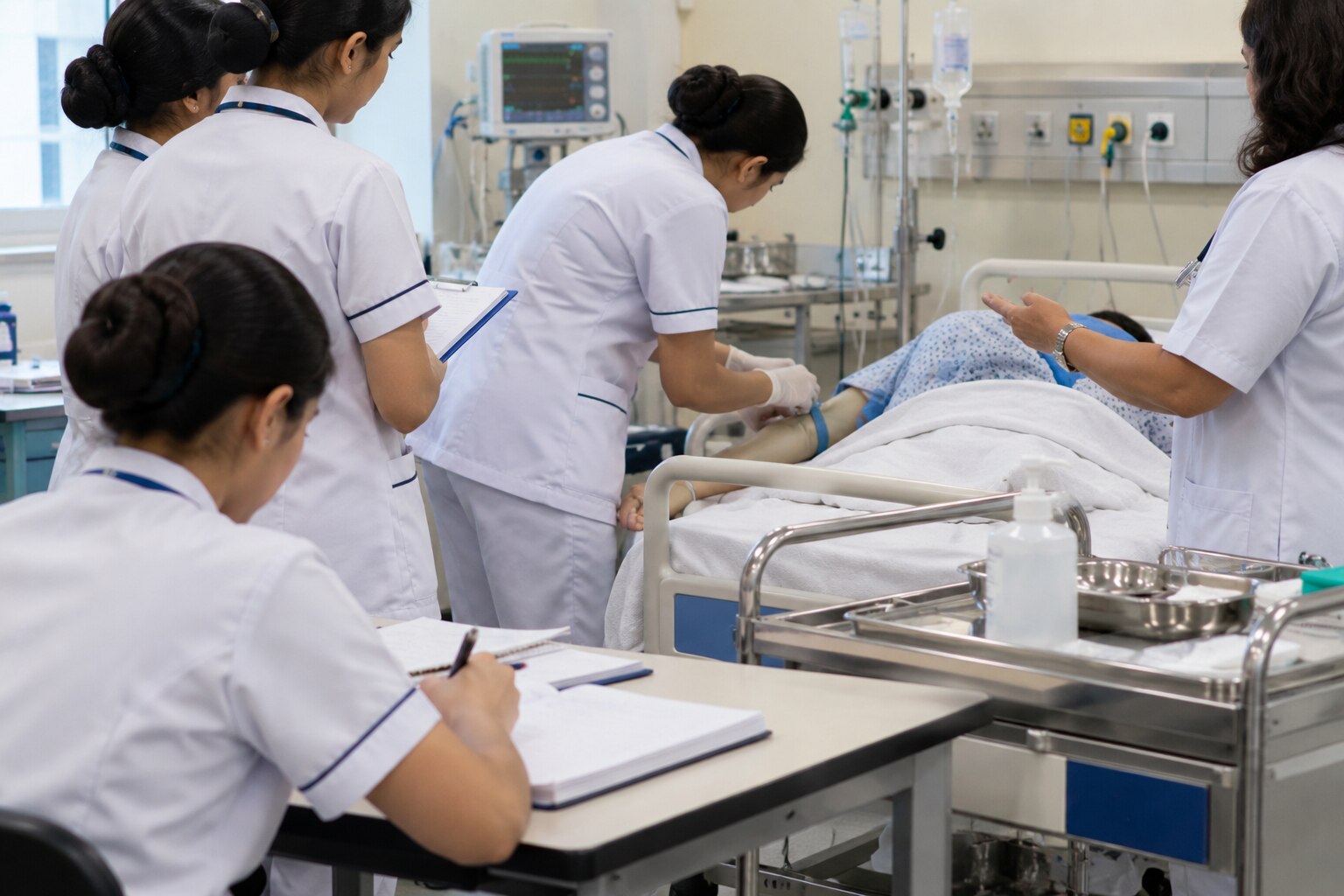
A nursing student can memorise procedure steps and still be unprepared to assess a deteriorating patient, communicate with a worried family, or document care safely. By understanding what supervised clinical training involves and how to evaluate it, you can distinguish meaningful preparation from hospital attendance that produces little practical competence.
Key takeaways
- Choose colleges with ward postings, community visits, skills labs and simulation.
- Ask how students progress from demonstration to supervised independent performance.
- Check posting records across medical, surgical, paediatric, obstetric and psychiatric nursing.
- Prioritise repeated practice with documented feedback before direct patient responsibility.
What does clinical training include in a GNM course?
Clinical training in a GNM course turns lessons into supervised patient care, not hospital observation alone. Students use anatomy and physiology to assess a patient, pharmacology to understand medicines, nutrition to support recovery, and nursing theory to plan care. They practise in wards, community settings, skills laboratories and simulation sessions.
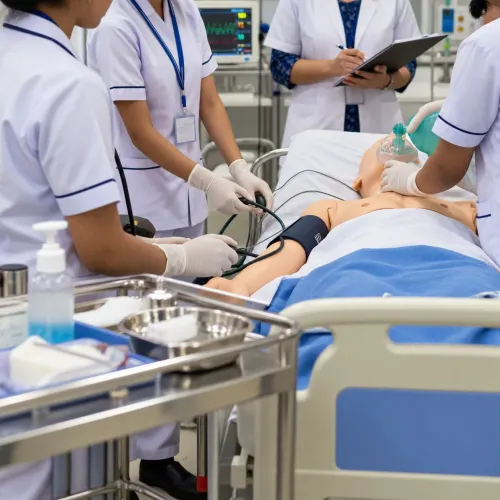
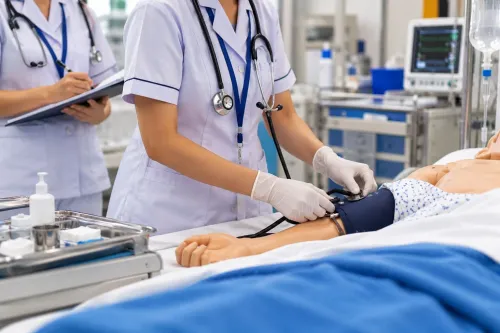
A supervised bedside encounter can include patient assessment, temperature, pulse, respiration and blood pressure measurement, nursing procedures, medication administration, wound care and infection prevention. Students also learn nursing documentation, safe handover and patient communication with patients and families. They must protect privacy, dignity and safety throughout the interaction.
A safe care sequence includes:
- Identify the patient, explain the procedure, obtain consent, perform hand hygiene and check risks such as allergies, pain, abnormal vital signs or infection.
- Decide why the procedure is indicated, select the correct equipment and apply the relevant anatomy, physiology, pharmacology or nutrition knowledge.
- Perform the procedure under supervision, using aseptic technique where required, and report deterioration, unexpected findings or errors immediately.
- Reassess the patient, record the response and findings, and communicate continuing needs during handover.
A GNM programme is incomplete when a learner can only recite steps. Competence means adapting those steps to a real patient’s condition, recognising when to seek help and evaluating whether care achieved its intended result.
How do students move from observation to safe performance?
Safe performance develops in three supervised stages, and progression depends on demonstrated competence rather than the number of weeks spent in a ward.
- Observation: watch a trained nurse or instructor perform the procedure, including patient identification, explanation, consent, hand hygiene, technique and documentation.
- Assistance: participate in selected steps while the supervisor controls the procedure and corrects errors immediately. This observation assistance stage builds judgement without transferring full responsibility.
- Performance: complete the procedure under direct supervision only after a return demonstration meets the required standard. The supervisor decides when the student may progress, not the calendar.
Before patient contact, a skills laboratory and simulation sessions provide controlled practice in hand hygiene, aseptic technique, dressing changes, medication checks, safe handover, resuscitation and emergency responses. Simulation is valuable for rare or high-risk events, but it supplements rather than replaces patient-based learning, where uncertainty, competing priorities and real responses matter.
Faculty assess supervised clinical practice through a skills checklist, return demonstration, case presentation, clinical evaluation, case records and an OSCE. Useful feedback names the failure: a missed identity check, contaminated technique or incomplete nursing note. The student then repeats the task safely, rather than merely receiving a mark.
A written examination can test recall; direct assessment shows whether the student can protect a patient during care.
Which clinical postings build a complete nursing foundation?
Clinical postings should span hospital, community and simulation settings so each GNM student practises assessment, care, documentation and referral across different patient needs. A complete foundation includes these learning areas:
| Area | Core learning | Evidence of supervised practice |
|---|---|---|
| Medical-surgical ward | Patient assessment, vital signs, medication safety, wound care, infection prevention and nursing documentation | Assessing patients, administering prescribed medicines, changing dressings and recording findings |
| Maternal health | Antenatal assessment, labour and birth, postnatal care, newborn care, complication recognition and referral | Midwifery training across the full care continuum, not delivery observation alone |
| Child health | Age-appropriate assessment, medication considerations and family communication | Explaining care to parents and responding to a child’s changing condition |
| Mental health | Therapeutic communication, observation, de-escalation and safety awareness | Building trust while recognising risk to the patient, family or staff |
| Community health | Prevention, health education, home-based assessment, maternal and child follow-up, immunisation-related work and referral | Community health nursing through supervised household and outreach visits |
| Emergency care | Rapid assessment, prioritisation, resuscitation and escalation | Responding to deterioration and competing demands under supervision |
Community health is clinical work, not an optional extra. Emergency simulation can rehearse medication errors, deterioration, resuscitation and emergency birth, but real placements teach students to manage uncertainty and actual patient responses. Watching a delivery or procedure does not equal competence; students must perform assessment, monitoring, documentation and escalation under supervision.
Why does repeated supervised practice matter for patient safety?
Repetition protects patient safety because it turns a correct-looking procedure into a reliable clinical decision. A student who practises assessment and care under clinical supervision learns to recognise abnormal vital signs, choose an appropriate intervention, preserve aseptic technique and explain when help is needed—not merely recite steps.
1. Link every action to its indication. Before care, confirm consent, assess the patient, perform hand hygiene and use the required aseptic technique. Busy wards make skipped hand hygiene feel harmless; contaminated equipment can instead spread infection.
2. Make patient identification and medication safety deliberate. Use the approved identifiers before giving any medicine, check the prescription and allergies, and stop when the patient, drug, dose, route or time does not match.
3. Rehearse safe handover. State the patient’s condition, change, action taken and follow-up needed, then escalate deterioration rather than hoping the next nurse notices it.
4. Complete nursing notes at the time of care. A late entry can omit a symptom, response or escalation; the clinical logbook should show what you performed, what you observed and what feedback changed, not serve as attendance paperwork.
Supervision must define which tasks a student may perform independently, which require direct observation and which require immediate help. Responsibility should follow demonstrated competence, not ward time. Reasonable rosters, breaks and accessible supervisors reduce fatigue and protect judgement. Students also need psychological safety to use incident reporting for errors, near misses and uncertainty without concealment.
Attendance alone proves little. Hours spent observing or doing routine service work are weaker than varied practice with feedback, repeat attempts and documented improvement.
How can you evaluate clinical training when comparing GNM colleges?
A reliable GNM college comparison starts with evidence of active, supervised clinical learning, not a polished brochure.
1. Verify current Indian Nursing Council recognition and the institution’s approval from the relevant State Nursing Council. Admission approval alone does not prove adequate bedside training.
2. Ask for the names of every teaching hospital and community site used by students. A teaching hospital affiliation can exist on paper while students receive little regular patient access.
3. Request the clinical rotation schedule. Check the posting dates, ward or department, number of visits, and frequency of student access for medical-surgical, maternal, newborn, emergency and community experiences.
4. Ask for the student supervisor ratio and identify who supervises each shift. Clarify whether students assess patients, administer medicines, change dressings and document care, or mainly observe and perform routine service duties.
5. Examine the clinical assessment process. Ask whether faculty use skills checklists, return demonstrations, case records, case presentations or objective structured clinical examinations.
6. Find out how feedback is delivered and what happens after a learner fails to demonstrate competence. A sound system provides correction, repeat practice and reassessment before allowing a task without direct supervision.
7. Confirm that emergency, maternal, newborn and community postings occur regularly rather than as occasional demonstrations. Hours alone prove little if students spend them watching procedures.
Use this checklist to assess Amar Professional College of Nursing alongside other providers; compare the transparency and activity of its clinical learning system, not the number of hospital names displayed.
Related product
 | ₹55000 Age: for entrance shall be 17 to 35 years as on 1st September of the year of Admission. View product → |
Frequently asked questions
What does clinical training include in a GNM course?
It includes supervised patient care in hospital wards, community settings, skills laboratories and simulation sessions. Students apply assessment, medication, nutrition and care-planning knowledge.
How do students move from observation to safe performance?
Students first watch demonstrations, practise skills in a laboratory or simulation, perform procedures under supervision, receive feedback and repeat them until they meet the required standard.
Which clinical postings build a complete nursing foundation?
A strong foundation includes medical-surgical wards, paediatric nursing, obstetric and gynaecological units, psychiatric nursing, community health and relevant specialty postings.
Why does repeated supervised practice matter for patient safety?
Repetition improves accuracy, communication and response to complications. Supervision lets instructors correct errors before they affect patients.
How can you evaluate clinical training when comparing GNM colleges?
Ask for the posting schedule, ward affiliations, skills-lab access, simulation opportunities, instructor-to-student supervision, attendance records and the process for competency assessment.