

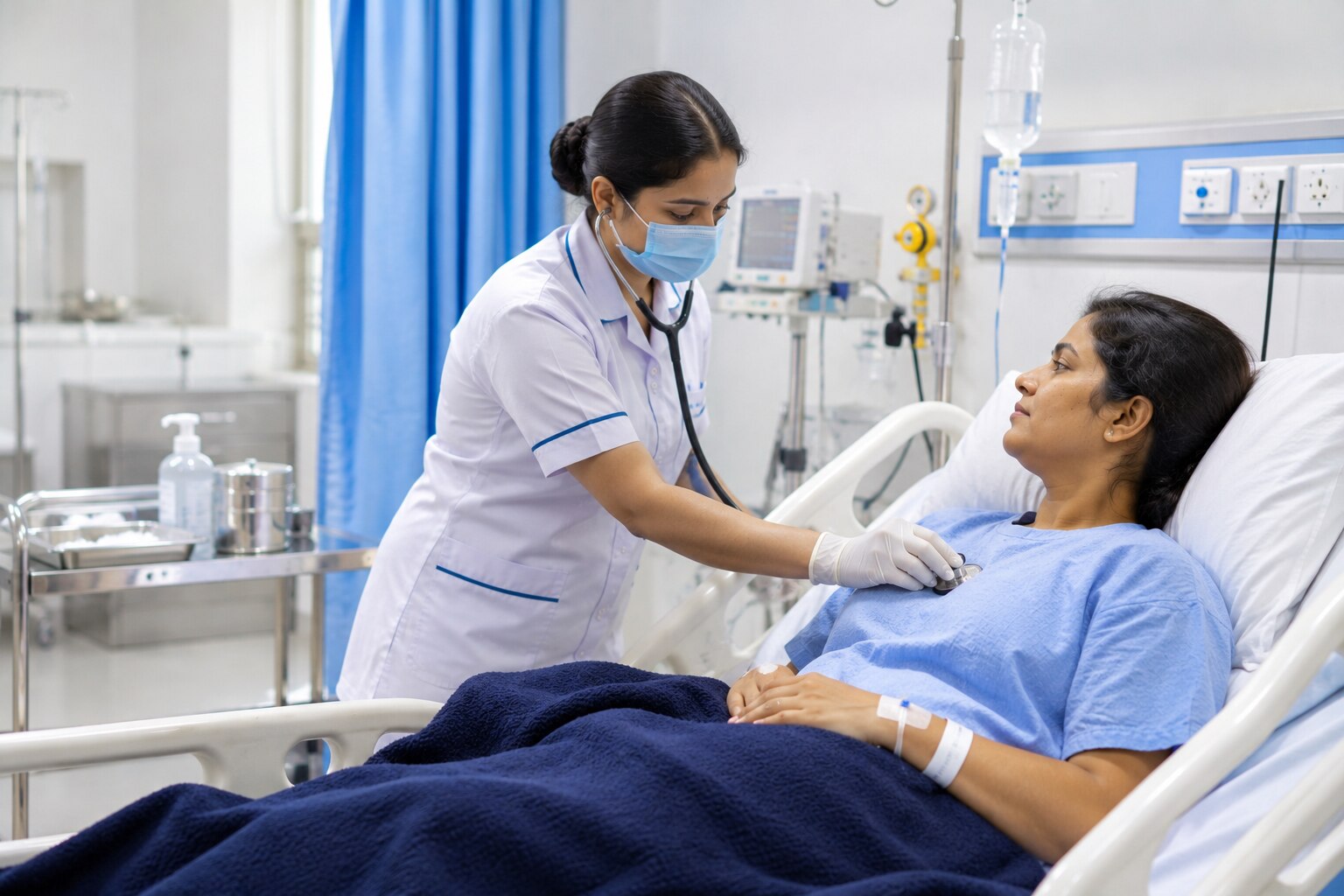
A G.N.M. student develops patient-care ability by moving from demonstrations and skill-lab practice to supervised work in wards, clinics, labour rooms and community settings. By the end, you should be able to identify the procedures, communication habits, safety checks and clinical evidence that show whether a programme has built usable nursing competence.
Key takeaways
- Compare rotations across medical-surgical, maternity, paediatric and psychiatric units.
- Check for supervised emergency, outpatient and community-health postings.
- Look for observed medication checks, infection-control practice and clinical handovers.
- Ask how the programme records competence during internship and clinical consolidation.
Where G.N.M. hospital training takes place
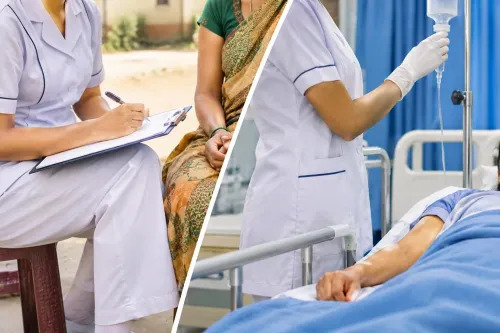
G.N.M. hospital training spans more than one ward. Students rotate through medical-surgical wards, obstetrics and midwifery units, paediatrics and child health nursing areas, psychiatric units, outpatient departments and emergency services. They also complete community-health postings and a supervised internship or clinical-consolidation period.
| Setting | Practical exposure | Skills and learning focus |
|---|---|---|
| Medical-surgical wards | Adult patients with medical and postoperative conditions | Observation, basic nursing care, documentation, wound care and recognising deterioration |
| Obstetrics and midwifery units | Antenatal, labour-room and postnatal care | Maternal assessment, delivery assistance, breastfeeding support and immediate newborn care |
| Paediatrics and child health nursing | Infants, children and newborns | Feeding assessment, growth observation, dehydration checks and respiratory-distress recognition |
| Psychiatric units and outpatient departments | Mental-health care, consultations and follow-up visits | Therapeutic communication, patient history, health education and referral |
| Community settings | Home visits, clinics, schools and public-health programmes | Maternal-and-child-health follow-up, sanitation, nutrition education, prevention and records |
Community nursing shows how care continues outside the hospital through family visits, immunisation-related education, communicable-disease prevention and referral work. During maternity placements, students learn to identify severe bleeding, eclampsia, prolonged labour, fetal distress and newborn breathing problems, then escalate these emergencies rather than manage them independently.
The depth of experience depends on patient volume, functioning equipment, qualified clinical instructors and supervised practice. A completed clinical logbook, signed skills checklist and documented ward and labour-room postings provide stronger evidence than a course brochure listing departments.
The bedside care skills students practise with patients
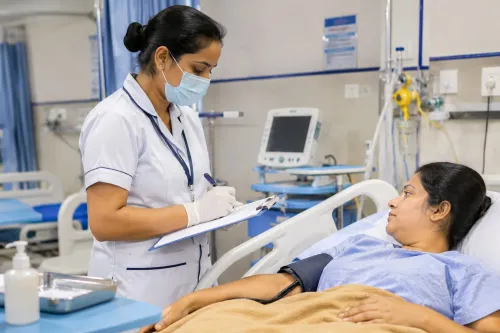
A G.N.M. student does not become competent by watching a bed bath once. Under a clinical instructor’s or staff nurse’s supervision, the student performs routine care, protects privacy, checks comfort and reports anything unusual. Repeated bedside practice turns each procedure into safe patient care.
| Procedure | What the student practises | What supervision checks |
|---|---|---|
| Vital-sign measurement | Measures temperature, pulse, respirations, blood pressure and oxygen saturation; asks about pain and level of consciousness | Equipment, technique, trend recording and escalation of abnormal findings |
| Bed making and positioning | Changes occupied beds, uses pillows and repositions dependent patients | Comfort, body mechanics, skin protection and pressure-injury prevention |
| Bathing and hygiene care | Provides bed baths, oral care, hair care, perineal care and linen changes | Dignity, clean-to-dirty sequence, skin inspection and infection prevention |
| Feeding and positioning patients | Sits the patient upright, assists feeding and records intake | Swallowing risk, pace, response and safe positioning |
| Mobility assistance | Helps patients sit, stand, transfer and walk with prescribed aids | Falls risk, safe technique and the level of assistance required |
| Wound, specimen and catheter care | Performs simple wound dressing, labels specimens and provides urinary catheter care | Aseptic technique, correct labelling, urine output and prompt reporting |
Students also practise intake-output charting, nursing notes and pain documentation. Each entry needs the time, observation, action and signature; missing records can hide deterioration and disrupt handover. Demonstrations must be followed by return demonstrations, supervised patient contact and dated competency records.
Medication safety, infection control and emergency support
A G.N.M. student is taught to stop before giving any medicine when the order, patient identity or allergy history is unclear. Medication administration includes prescription checks, confirming the patient, medicine, dose, route and timing, completing dose calculation, and recording the administration immediately.
The familiar “five rights” do not replace the prescription, identity checks or local policy.
Injection safety combines correct technique with infection control. The student uses a new sterile needle and syringe for every injection, never reuses a single-dose vial for another patient, performs hand hygiene and disposes of sharps safely. After administration, the student observes for allergy, respiratory difficulty, pain, bleeding or other adverse reactions and reports them promptly.
During a sudden deterioration, supervised training gives students a clear response sequence:
- Recognise danger signs such as unresponsiveness, absent or abnormal breathing, severe bleeding, seizures or sudden confusion.
- Call for help, assess airway and breathing, provide basic life support within training and local protocol, and control visible bleeding.
- Give oxygen or assist with suctioning and emergency procedures as directed, while recording observations and interventions.
- Escalate immediately rather than attempting advanced airway management, emergency drug selection or independent diagnosis.
Midwifery practice adds recognition of heavy bleeding, eclampsia, fetal distress and newborn breathing problems. These findings require urgent senior review and referral, not independent treatment.
How students demonstrate competence and communicate clinical changes
Competence is shown by what a student can safely perform, record and report—not by attendance at a ward demonstration. Clinical assessment tests technique, patient observation, documentation and the judgment to seek help before a small change becomes a serious problem.
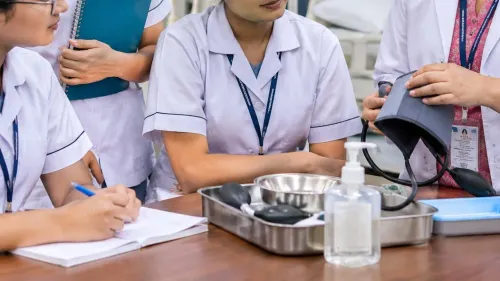
- Skill-lab sessions assess preparation, infection-control steps, equipment handling and the correct sequence for procedures.
- Return demonstrations require the student to perform a procedure independently while an instructor checks technique against a skills checklist.
- Supervised bedside practice tests whether the student can adapt safely to a real patient, explain the procedure, protect privacy and recognise discomfort or risk.
- Case studies and questioning assess clinical decisions, such as prioritising care, withholding an unsafe action and escalating a worsening condition.
Students record completed procedures, patient findings and instructor feedback in clinical logbooks. A signed and dated entry is stronger evidence than a tick showing that a demonstration occurred; missing signatures, copied observations or unexplained gaps weaken continuity of care.
Communication is assessed through nursing notes, intake-and-output records, care plans, handover and incident reports. A useful handover states the patient’s identity, current finding, change from baseline, action taken and response. Report a new breathing difficulty, altered consciousness or sudden fall in blood pressure immediately to the supervising nurse; do not wait to complete paperwork.
Clear escalation shows that the student can connect observation with safe clinical action.
How to judge the practical value of a G.N.M. programme
Ask to see evidence, not promises: a completed clinical logbook, signed and dated skills checklist, and clinical competency records. Request the names and capacity of affiliated hospitals, ward and labour-room posting frequency, and the student-to-instructor arrangement. A brochure listing procedures proves only that someone printed a list.
| Evidence | Strong sign | Weak sign |
|---|---|---|
| Clinical exposure | Named hospitals with medical-surgical, maternity, paediatric and community postings | “Hospital training” with no locations, departments or posting schedule |
| Supervision | A stated student-to-instructor arrangement and documented procedure verification before patient practice | Students describe watching demonstrations without return demonstrations |
| Assessment | Completed logbooks, signed skills checklists and clinical competency records with dates and assessor names | Blank forms, copied entries or attendance sheets presented as competence |
| Facilities | Working simulation equipment, practice time and access to oxygen, suction and dressing supplies | A skills laboratory shown only during an admission visit |
| Patient volume | Hospital data or rotation records showing regular maternity, paediatric and general-ward cases | A prestigious affiliation that gives students little bedside access |
Ask Amar Professional College of Nursing 08048059238 to show a sample anonymised logbook and explain who signs each procedure, how failed attempts are remediated, and when independent performance is permitted.
Check whether records include vital signs, intake and output, medication administration, nursing notes, handover and escalation. Missing times, signatures or abnormal-observation follow-up reveal weak clinical discipline.
- How many ward and labour-room shifts does each student complete?
- Which procedures require return demonstration?
- Who audits clinical records and investigates missed competencies?
Frequently asked questions
Where does hospital training take place during a G.N.M. course?
Students rotate through medical-surgical wards, obstetrics and midwifery, paediatrics, psychiatric units, outpatient departments and emergency services. They also complete community-health postings and supervised internship or clinical-consolidation training.
Which patient-care skills do G.N.M. students practise?
Students practise bedside care such as observing patients, recording vital signs, supporting hygiene and mobility, assisting with nutrition, maintaining comfort and reporting changes to supervisors.
How do G.N.M. students demonstrate clinical competence?
They demonstrate competence through supervised procedures, accurate documentation, medication-safety checks, infection-control practice, emergency support and clear communication during clinical handovers.
How can you judge the practical value of a G.N.M. programme?
Compare the range of clinical postings, the amount of supervised patient contact, the way skills are assessed, the quality of feedback and the structure of internship or clinical consolidation.