


A nursing student can memorise disease signs, medication principles and procedure steps without being ready to care for a changing, anxious or medically complex patient. By the end, you will know what meaningful clinical exposure includes, how it builds competence safely, and what to ask when comparing B.Sc. Nursing courses.
Key takeaways
- Ask how many clinical areas students rotate through.
- Confirm students perform procedures under direct supervision.
- Look for placements in medical-surgical, paediatric and community settings.
- Check how the college assesses safety, communication and clinical judgement.
What students actually learn through clinical exposure
Clinical exposure means working with real patients under a registered nurse’s or clinical instructor’s supervision, not standing beside a nurse and watching. A meaningful placement gives students opportunities to:
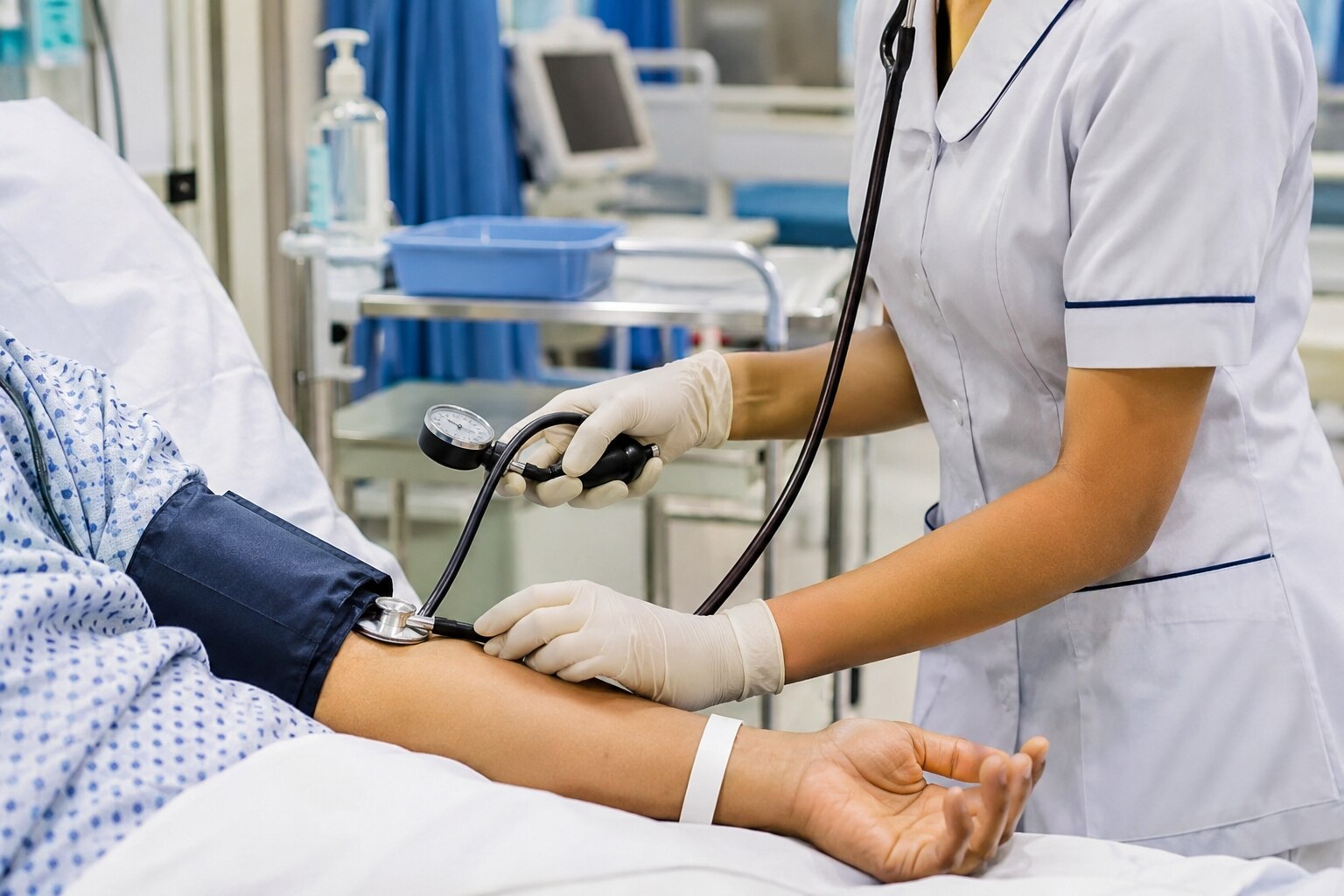
- Perform supervised patient assessment, including history taking and vital-sign measurement.
- Relate assessment findings to anatomy, physiology, pharmacology and the patient’s immediate needs.
- Practise permitted medication administration and wound care while checking identity, orders and infection-prevention precautions.
- Document findings, nursing actions and patient responses in the clinical record.
- Provide health education and participate in care planning with the patient and healthcare team.
Classroom teaching can explain a procedure in the correct order; it cannot reproduce a frightened patient, an incomplete history, a language barrier or vital signs that change during care. A student may recall the steps for taking blood pressure yet struggle to position a weak patient safely, recognise an unexpected reading or report deterioration clearly.
Clinical exposure connects subjects taught separately when one patient has several needs at once. Students learn to communicate during handover, adapt instructions, protect privacy and ask for help before a small concern becomes an emergency. Feedback from supervisors exposes unsafe shortcuts while the student is still learning, making practice safer before independent responsibility begins.
Observation has value at the start, but competence develops when students assess, act, document and reflect under supervision.
How supervised practice turns procedures into competence
A student should not move from watching a wound dressing to performing it alone after one demonstration. Progression is staged: observation builds a mental model, simulation allows repetition without patient risk, and supervised care tests whether the skill holds in real conditions.
1. During a demonstration, the student watches the sequence, infection-control decisions, patient communication and documentation. In simulation, the student practises until the technique is consistent, including responding to a deteriorating vital sign or an error.
2. With clinical instructors nearby, the student performs permitted tasks for an actual patient, beginning with focused assessments and basic care. Ward nurses add practical context about the patient’s routine and changes, while the instructor checks consent, identity, technique and escalation.
3. Responsibility expands only after observed competence. The student assesses the patient, plans care, administers medication within authorised scope and institutional policy, documents the action, and reports the response. Medication competence requires checking the patient, drug, dose, route, timing, allergies and indication—not merely giving a dose.
4. After each attempt, feedback identifies what was safe, what was missed and what to practise next. Repeated practice with feedback turns a memorised procedure into reliable judgement, while the supervisor retains accountability for assigned care.
A longer placement is not automatically better. Hours spent watching staff or completing non-nursing tasks cannot replace opportunities to perform, explain, document and review care under supervision.
Why students need experience across different clinical areas
A student who has worked only on one ward may perform familiar tasks yet miss how nursing changes with age, setting and patient need. Rotations expose those differences and connect anatomy, physiology, pharmacology, nutrition, psychology and ethics to one patient’s combined needs.
Each clinical area develops a different form of judgement. Medical-surgical wards build assessment and prioritisation for multiple illnesses; obstetrics and gynaecology require attention to pregnancy, childbirth and reproductive health; paediatrics demands age-appropriate observation and communication; psychiatric nursing depends on therapeutic communication, risk assessment and respect for dignity.
Community placements add prevention, home assessment, health education, referral and continuity of care, while high-acuity settings sharpen recognition of deterioration and rapid escalation.
Use this checklist to judge whether the rotations offer genuine learning:
- Medical-surgical wards: assess changing conditions, organise care and report abnormal findings.
- Obstetrics and gynaecology: support mothers and families while protecting privacy and informed consent.
- Paediatrics: adapt assessment, explanations and safety measures to a child’s developmental stage.
- Psychiatric nursing: listen without judgement, identify risk and maintain professional boundaries.
- Community health: assess living conditions, provide prevention education and arrange follow-up.
- High-acuity settings: interpret vital-sign trends, use infection precautions and escalate emergencies.
- Geriatric care: manage frailty, multiple medicines, falls risk and continuity between services.
Across every placement, students should introduce themselves, obtain consent, document care and receive feedback from supervisors. The goal is not to collect ward hours; it is to practise safe decisions with different patients before independent responsibility.
How placements develop safety, communication and professional judgement
Real patient care builds safety habits through repetition, context and consequences. A student learns that hand hygiene is not a memorised rule: the WHO five moments place it before patient contact, before a clean procedure, after body-fluid exposure risk, after patient contact and after touching the patient’s surroundings. Skipping one moment can transmit infection.
Under supervision, students practise safety behaviours that a classroom cannot fully reproduce:
- Confirm patient identification before giving medication, collecting specimens or performing procedures; the wrong identity can turn a correct treatment into harm.
- Complete medication checks against the prescription, patient, dose, route, time and documentation before administration.
- Use standard precautions, recognise deterioration and escalate abnormal findings instead of waiting for a routine review.
- Obtain consent, introduce themselves as students and protect confidentiality during assessment and care.
A placement also makes communication accountable. Students explain care in language a patient understands, respect cultural preferences, document findings, give structured handovers and work within professional boundaries. They learn to report bad news only within their role and involve the appropriate clinician when a conversation exceeds their responsibility.
Professional judgement develops when one patient has competing needs: pain, anxiety, mobility risks and an altered vital sign cannot be managed as separate textbook questions. Feedback after real encounters helps students decide what requires immediate action, what can wait and when to ask for help.
Simulation supports repeated practice, but it cannot reproduce unpredictable symptoms, emotion, privacy and team pressure.
How to judge the quality of a B.Sc. Nursing clinical programme
Ask a college to show how its clinical rotation is taught, not just the total hours advertised. A credible programme provides named learning objectives, varied patient exposure, direct supervision and documented feedback; it does not use students mainly for routine service work.
1. Request the rotation plan for medical-surgical, maternity, paediatric, psychiatric, community, emergency and critical-care placements. Check whether students assess patients, document findings, join care planning and communicate with the healthcare team rather than watch staff work.
2. Ask who supervises each placement and how many students one nurse oversees. Confirm that students perform procedures only within demonstrated competence, with a registered nurse or authorised practitioner available for higher-risk care.
3. Examine the competency assessment process. A signed checklist for injections or vital signs is insufficient unless students also show clinical decision-making, recognise deterioration, adapt care and report findings accurately.
4. Ask how feedback and safety concerns are handled. Look for prompt, specific correction after an error, a clear incident-reporting route, student feedback on each ward and reflective clinical records that connect patient encounters to improved practice.
Before choosing Amar Professional College of Nursing 08048059238, ask for these documents and examples rather than accepting placement hours as proof of learning. A shorter placement with active practice and feedback can teach more than a longer placement dominated by observation.
Related product
 | ₹60000 • The candidate should have passed 12 years of schooling from recognised school. View product → |
Frequently asked questions
What do B.Sc. Nursing students learn through clinical exposure?
Students practise patient assessment, documentation, communication, procedures and care planning with real patients under supervision.
How does supervised practice build nursing competence?
Students first observe, then perform procedures with guidance and receive feedback until they can complete them safely and consistently.
Why should nursing students train across different clinical areas?
Different wards expose students to varied diseases, age groups, treatments, emergencies and patient-care priorities.
How do clinical placements develop professional judgement?
Students learn to identify risks, prioritise care, communicate changes and decide when to seek help from a registered nurse or instructor.
How can you judge the quality of a B.Sc. Nursing clinical programme?
Ask about placement sites, rotation schedules, instructor supervision, student-to-instructor ratios, skills assessments and procedures students are allowed to perform.