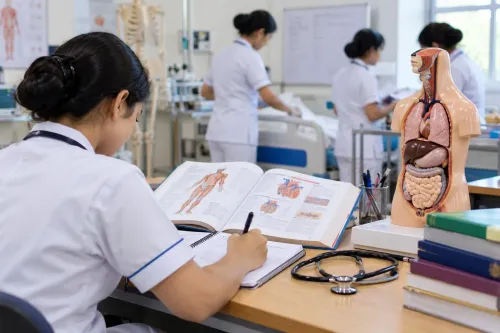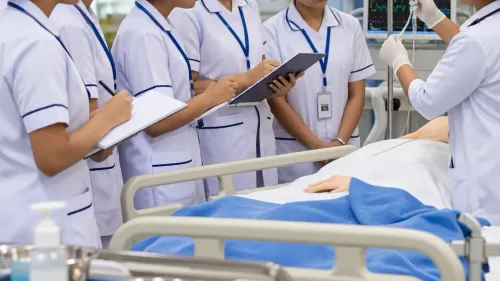


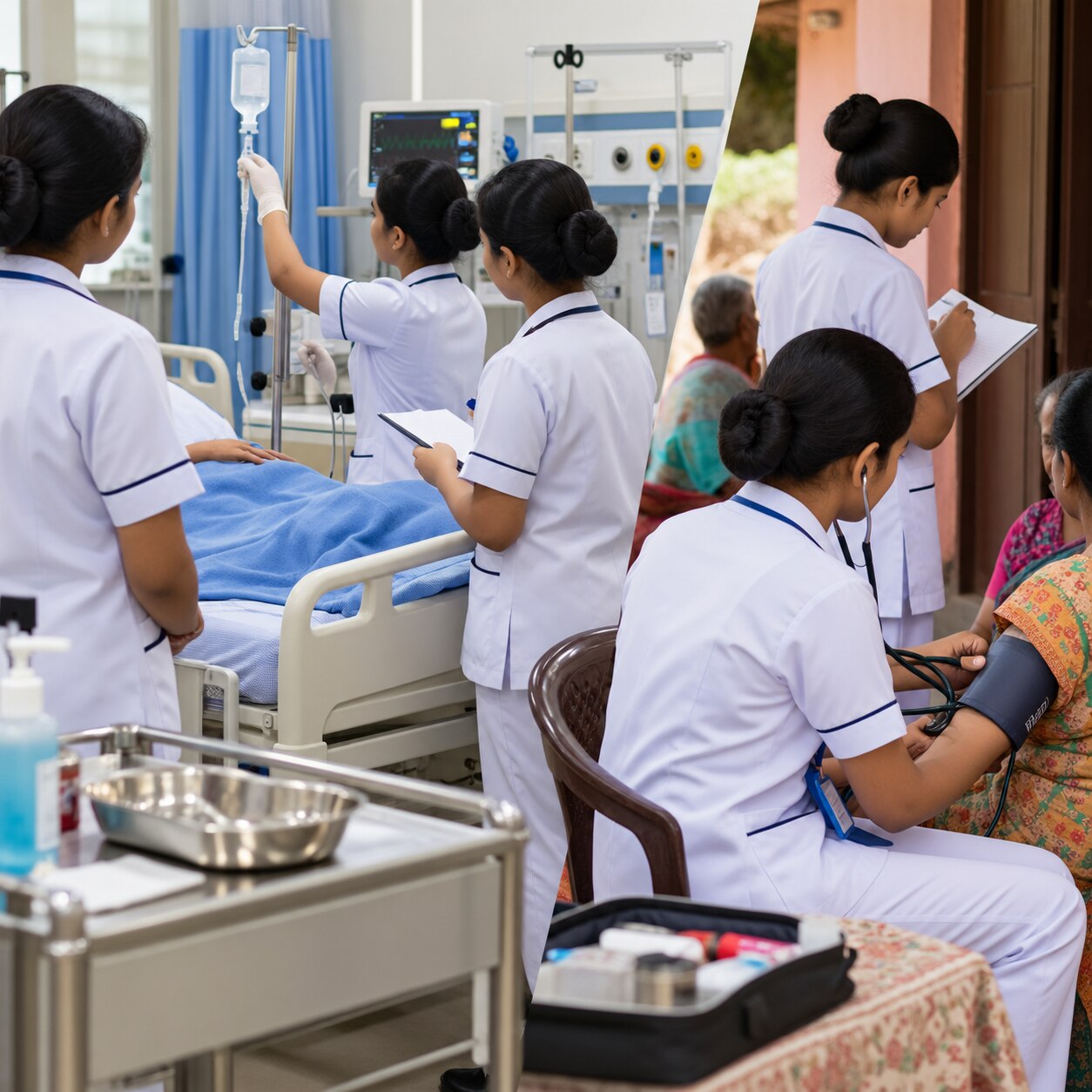
Hospital nursing and community nursing use the same professional foundation, but they differ in setting, priorities, records, resources and the people included in care. By following how GNM students move from classroom learning to supervised practice, you can see how the course prepares them to assess patients, support families, document care and recognise when referral is needed.
Key takeaways
- Compare ward care with family-focused community nursing.
- Trace anatomy, pharmacology and assessment into daily hospital duties.
- Look for supervised ward rotations, home visits and referral practice.
- Check whether students write care plans, handovers and community records.
How hospital and community nursing differ in daily practice
Hospital nursing focuses first on one patient’s immediate condition: vital signs, treatment, hygiene, comfort and recovery. Community nursing widens the unit of care to the family, household environment and risks affecting health.
| Setting | Daily priority | Typical workflow and support |
|---|---|---|
| Hospital wards | Monitor illness, provide treatment, prevent complications and prepare discharge | Shift-based rounds, charts, medication schedules and close access to doctors, equipment and treatment areas |
| Outpatient department nursing (OPD) nursing | Assess brief visits, support procedures, teach patients and identify deterioration | Rapid turnover, focused assessment and same-day follow-up or referral |
| Emergency, operating and recovery units | Recognise danger signs, maintain safety and support stabilisation or recovery | Fast handovers, strict procedures and immediate access to specialised teams |
| Primary health centre, outreach sites and patients’ homes | Assess the person, family, household environment, finances, health knowledge, transport and access to services | Scheduled visits, community surveys, screening, health education, immunisation support and follow-up |
A hospital nurse works within a structured team and can obtain investigations or treatment quickly. A community nurse may work with limited supplies, so recognising danger signs, giving immediate nursing measures and arranging referral become central responsibilities.
Students need both experiences because the priorities change, not merely the location. In hospital, a shift may involve medication administration, wound care or post-operative observation; in community nursing, a visit may reveal unsafe medicine storage, poor nutrition or a caregiver unable to reach the primary health centre.
Moving between settings teaches how community nurses identify needs, hospital teams stabilise and treat patients, and families continue care after discharge.
How classroom subjects become hospital nursing duties
A GNM hospital posting turns classroom knowledge into a sequence of patient-care decisions, beginning with an admission assessment and continuing through discharge teaching. Anatomy and physiology help students interpret pain, breathing, circulation and altered consciousness; health assessment helps them decide what to report.
1. In the skills lab, students practise vital-sign monitoring, nursing care planning, bed making and patient hygiene before entering a clinical area. They connect each observation to a care action rather than memorising isolated procedures.
2. Under supervision, students perform medication administration using pharmacology-based checks: the correct patient, medicine, dose, route, time, allergy information and documentation. They also practise wound care and infection prevention, because a skipped hand-hygiene step can contaminate a dressing or expose another patient.
3. Students learn three different levels of participation: observing a procedure builds familiarity, performing it with guidance develops technique, and competency assessment tests whether they can complete it safely, accurately and consistently. Watching a nurse insert a catheter does not prove that the student can do it.
4. General wards develop routine monitoring and handover skills, while OPDs bring rapid assessments and short patient contact. Emergency units add urgency and prioritisation; operating and recovery units expose students to sterile equipment, anaesthesia-related observation and close post-procedure monitoring.
The patient journey makes the connection visible: assess, record, plan, provide care, monitor response and teach the patient before discharge. Each GNM hospital posting reinforces that sequence under clinical supervision.
How community postings connect care, prevention and referral
Community postings teach students to connect individual care with prevention. Through household visits, family assessment, community surveys, school and outreach activities, students practise health education, immunisation support, maternal and child health services, nutrition guidance, screening and communicable-disease prevention.
Midwifery is central to this learning. Antenatal monitoring helps students recognise pregnancy risks; intrapartum experience shows how timely action protects mother and baby; postnatal and newborn care continue after discharge. Students learn to explain medicines, check safe storage, confirm access to refills and ask whether the person knows which adverse effects require help.
The referral chain is practical, not theoretical:
- A community nurse identifies danger signs, gives immediate advice and arranges referral to the appropriate facility.
- Hospital staff assess, stabilise or treat the patient and provide discharge instructions.
- Community nurses and family caregivers continue follow-up, monitor recovery and report deterioration.
Infection prevention changes with the setting, but the purpose remains the same.
| Setting | What students practise | What can go wrong |
|---|---|---|
| Hospital | Hand hygiene, PPE, safe injection practice and clinical waste disposal using dedicated supplies and isolation areas | A missed precaution can expose patients and staff across a busy ward |
| Home or outreach | Hand hygiene, appropriate PPE, safe injection practice and waste segregation with portable supplies and no dedicated isolation room | Limited space or missing containers can cause contamination unless the nurse plans before starting |
This is community health nursing: care, prevention, referral and follow-up joined into one patient journey.
How practice, communication and records build continuity of care
Continuity of care depends on what a GNM student learns, practises, communicates and records—not on classroom theory alone. Assignments connect theory to cases, skills-lab practice develops technique, and supervised hospital and community postings show how care changes across settings. Clinical records link these experiences to accountable practice.
Communication skills must change with the listener without changing the facts. Students obtain consent from patients, explain care in understandable language to relatives, confirm instructions with doctors, report deterioration promptly and give a structured handover to the next nurse or multidisciplinary team. A handover that omits a new symptom can delay treatment.
Each record answers a practical question for the next caregiver:
- Nursing notes show what the patient reported, what the nurse observed, what care was given and how the patient responded.
- Intake and output charts show fluid balance and support decisions about monitoring or escalation.
- Medication records show the medicine, dose, route, time and response, reducing omitted or duplicated doses.
- Care plans show identified problems, planned actions, goals and required review.
- Referral notes explain the concern, findings, immediate measures and reason for transfer.
- Discharge instructions state medicines, warning signs, follow-up and home-care responsibilities.
- Community-visit records show household findings, teaching, referrals and the next follow-up date.
Every entry needs the date, time, observation or action, patient response and follow-up. Never guess, copy forward an unchanged finding or leave a later caregiver to reconstruct events.
Emergency recognition separates noticing deterioration from giving immediate nursing measures and arranging escalation or transport. In a community facility with limited diagnostic and treatment resources, early referral can protect the patient while hospital staff continue stabilisation and treatment.
How to judge whether a GNM course offers meaningful clinical exposure
A credible GNM course proves its clinical exposure with records, not descriptions. Before choosing a GNM course, ask for:
- The names of clinical affiliations, affiliated hospitals and community facilities.
- The wards and departments covered by hospital postings, including medical-surgical wards, OPD, emergency, operating or recovery areas.
- Community postings at a primary health centre, outreach site and patients’ homes.
- The total supervised clinical time, patient volume, skills lab access and schedule for hands-on midwifery exposure.
- Whether students perform procedures under supervision or only watch them.
- How attendance is recorded, who reviews clinical logs and how missed postings are rescheduled.
| Clinical evidence | What to verify | Warning sign |
|---|---|---|
| Hospital exposure | Named hospitals, departments, patient numbers and duty schedules | “Hospital training” without a roster or posting plan |
| Community exposure | Family assessments, home visits, health education, referrals and primary health-centre work | Community learning limited to classroom descriptions |
| Skill evaluation | Demonstration, supervised performance and documented competency assessment | Attendance recorded without skill sign-offs |
Also check accreditation and regulatory recognition with the relevant nursing authority; a course title alone does not establish approval. Ask how students move from recognising deterioration to giving immediate nursing measures and arranging referral.
For Amar Professional College of Nursing, ask how its Chandigarh clinical roster covers hospital and community settings, which records students maintain and how supervisors sign off skills. Choose documented placements, supervision and real opportunities to practise the referral chain over promotional claims.
Related product
 | ₹55000 Age: for entrance shall be 17 to 35 years as on 1st September of the year of Admission. View product → |
Frequently asked questions
How do hospital and community nursing differ in daily practice?
Hospital nursing concentrates on one patient’s immediate condition, including vital signs, treatment, hygiene, comfort and recovery. Community nursing considers families, households, prevention risks and access to care.
How do classroom subjects become hospital nursing duties?
Subjects such as anatomy, pharmacology, nutrition and nursing procedures support duties including patient assessment, safe medicine administration, hygiene care, observation and documentation.
How do community postings connect care, prevention and referral?
Community postings show students how to assess household health risks, provide health education, support prevention and refer patients to appropriate hospitals or health services.
How can you judge whether a GNM course offers meaningful clinical exposure?
Ask for the clinical rotation schedule, hospital and community placement details, supervision arrangements, student responsibilities and examples of care plans, handovers and records.