

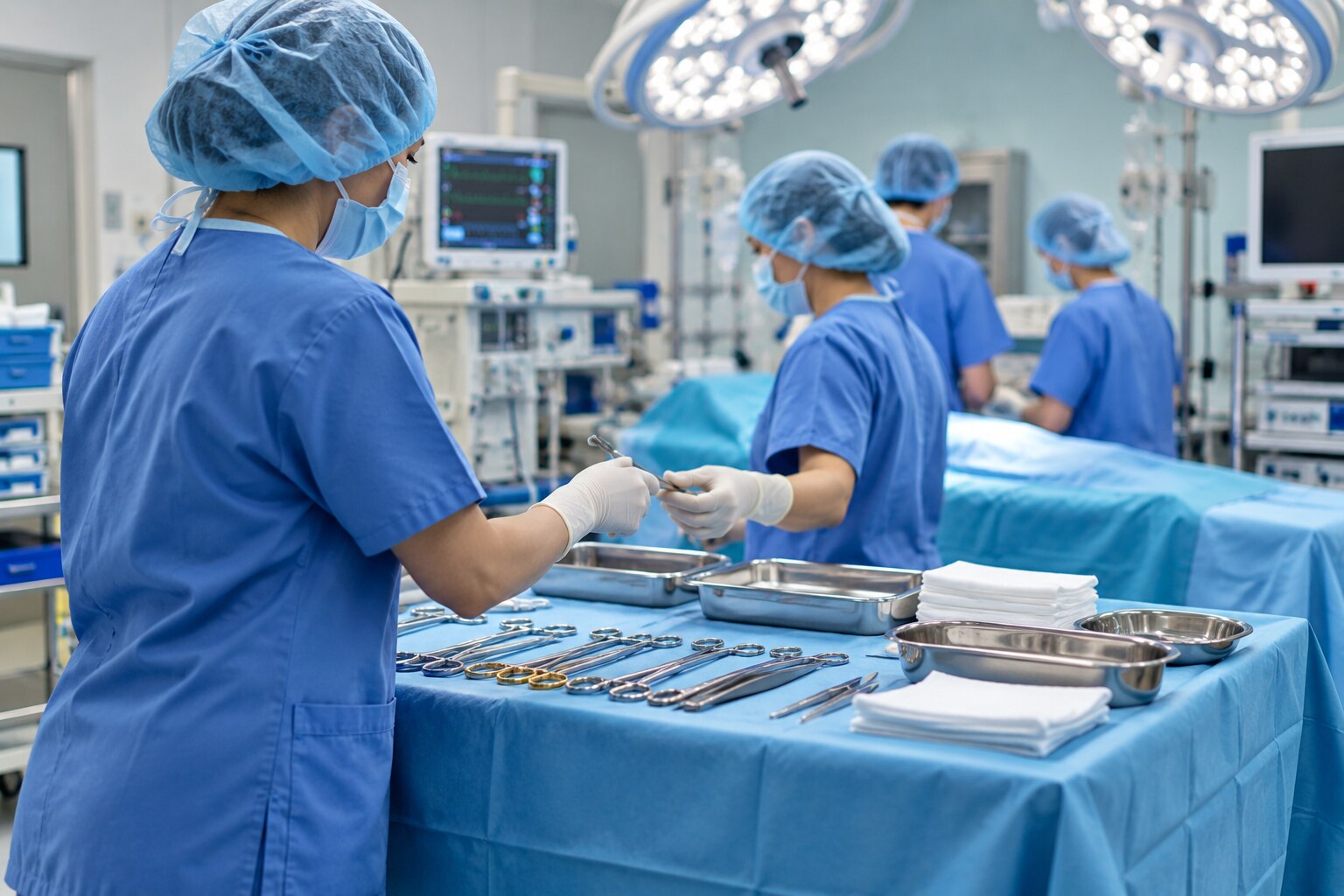
A new OT attendant must learn more than where equipment is stored: each movement, handover and cleaning step affects infection control and patient safety. By the end of the training, students should be able to recognise theatre zones, follow the operation sequence, support the clinical team within their role and report problems before they become hazards.
Key takeaways
- Follow the theatre route and change into approved attire before entering restricted zones.
- Track the patient’s identity, preparation and transfer at each stage of the operation.
- Handle instruments, waste and supplies without breaking sterile-field boundaries.
- Practise infection control through cleaning, traceability and supervised theatre routines.
How students learn theatre zones and sterile-field discipline
Before entering, students learn that operation theatre zones control movement, clothing and access. They practise restricted-area access by following the facility’s route, changing into theatre attire, covering hair and footwear, wearing a mask where required, and avoiding unnecessary movement or conversation.
The zones are taught as a practical boundary system:
- Unrestricted: ordinary clothing and initial reception areas are permitted.
- Semi-restricted: theatre attire is required, and traffic is limited.
- Restricted: the operating room and sterile-storage areas require theatre attire, controlled entry and strict aseptic behaviour.
Students learn surgical asepsis as a chain of small decisions. They keep sterile packs dry, sealed and above contaminated surfaces; never reach across a sterile field; and report a torn package, wet pack or suspected contamination instead of silently continuing.
Their role is to support the sterile team, not touch sterile instruments or make clinical decisions without instruction.
Hand hygiene comes before gloves and after their removal. Students practise the hand-scrubbing technique for OT staff support personnel, not the surgical scrub, for the duration set by facility policy. They use soap and water when hands are visibly dirty and an alcohol-based hand rub when appropriate, then dry hands completely before gloving.
Gloves do not replace hand hygiene, as stated in the WHO Guidelines on Hand Hygiene in Health Care. They also keep nails short and clean, with no nail polish or jewellery that can harbour contamination.
How a course follows the patient through the operation
Students practise the patient’s journey as a controlled sequence: reception, verification, preparation, table transfer, positioning, operation support and handover to recovery. The exact order changes with the procedure and local policy, but skipped checks can delay surgery or harm the patient.
1. Receive the patient and confirm identity using at least two identifiers, such as full name and date of birth or hospital number. Match the records, procedure, surgical site and signed consent, then report any discrepancy before transfer or incision.
2. Complete preoperative preparation with the clinical team. The student learns where to confirm fasting status, allergies, required equipment and baseline observations without making clinical decisions.
3. Support the operating-table transfer and positioning under clinical-team direction. The attendant does not determine position alone: the team considers anaesthesia and airway considerations, immobility, pressure injury and nerve injury risks. Practised safeguards include pressure-point padding, body alignment, fall prevention, and protection of lines, drains and monitoring equipment.
4. Observe the WHO Surgical Safety Checklist at its three checkpoints: before induction of anaesthesia, before skin incision and before the patient leaves the operating room. The attendant helps with directed identity, procedure, site, equipment, count, specimen and transfer checks.
5. Support skin preparation, draping, supplies and safe movement during the operation. Escalate a missing item, damaged equipment or unexpected change instead of guessing.
6. Label and pass specimens according to local procedure, then help transfer the patient, lines and documentation to recovery staff. Give a clear handover and assist with post-procedure cleaning only after the patient is safely received.
What equipment and support duties are demonstrated
An OT attendant learns to prepare, identify and pass support items without choosing treatment. Demonstrations may include scalpel handles, artery forceps, tissue forceps, needle holders, retractors, surgical scissors, instrument trays, drapes, cautery units and basic surgical equipment.
Students also practise operating-table controls, safe movement, padding, line protection, oxygen and gas-line awareness, and reporting faults before use.
| Support area | What the attendant demonstrates | What remains with clinical staff |
|---|---|---|
| Instruments | Count, arrange and pass named instruments such as forceps, retractors and needle holders | Select the operative technique or decide which instrument is clinically required |
| Operating table and equipment | Use approved table controls, check brakes, cables, cautery accessories and visible damage | Choose patient position, energy settings or treatment |
| Suction system | Check tubing, collection canister, vacuum source, overflow protection, and function before use | Manage an airway or suction independently beyond training and direction |
| Emergency readiness | Locate oxygen, suction, fire extinguishers, emergency call system, resuscitation equipment, spill kits and evacuation routes | Administer drugs, lead resuscitation or make airway decisions |
Emergency checks are reported promptly rather than silently corrected. The attendant may support identity, procedure, site, equipment, swab and instrument counts, specimen labelling, and transfer checks at the WHO Surgical Safety Checklist points, while the accountable nurse, surgeon or anaesthesia professional confirms clinical decisions.
WHO Basic Emergency Care supports staying within training and direction during airway and suction emergencies.
How infection prevention and traceable handling are practised
A practical exercise connects cleaning, disinfection and sterilisation without treating them as synonyms. Cleaning removes blood and tissue; disinfection reduces microorganisms on suitable surfaces; sterilisation uses an approved process for instruments that must be free of viable microorganisms. Sending an instrument forward with soil in a hinge, serration or lumen can undermine the entire process.
Students practise the instrument decontamination workflow:
- Contain used instruments at the point of use.
- Transport them in a closed, labelled system.
- Decontaminate and clean each part.
- Inspect hinges, serrations and lumens.
- Package compatible items correctly.
- Sterilise them by the approved method.
- Store and check the pack before issue.
Sterilisation indicators support traceability but do not prove that every item is sterile. An external chemical indicator shows that a package went through processing; an internal indicator assesses conditions inside it. Mechanical records, chemical indicators and, where required, biological monitoring are reviewed under facility policy.
Training also covers sharps disposal and biomedical waste segregation under facility policy. Needles and blades are not casually recapped or passed hand-to-hand; sharps go directly into puncture-resistant containers.
Colour codes and container rules vary by jurisdiction, as the WHO Safe Management of Wastes from Health-Care Activities explains, so use the facility’s labelled containers rather than an online chart.
For specimens, students practise confirming identifiers, securing leak-resistant containers and sending them through the designated route. A torn pack, spill, wrong container or failed indicator is isolated, reported promptly and documented with the load, time and location.
What supervised theatre practice reveals about the job
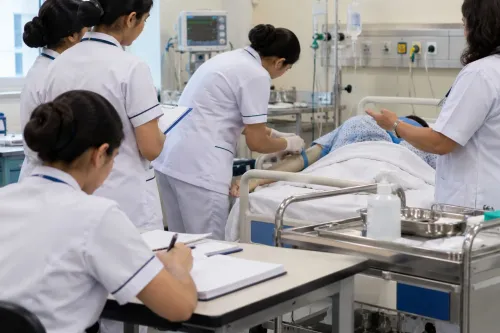
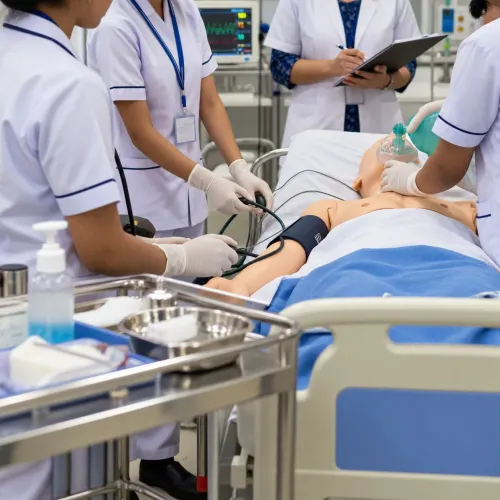
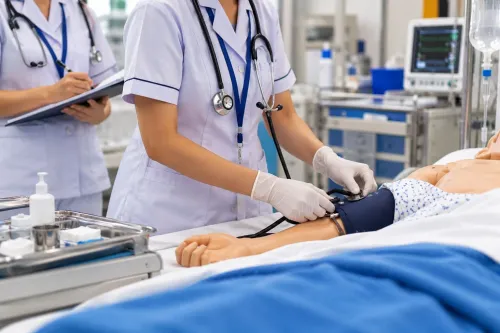
A supervised demonstration should show more than where supplies are kept. Expect to practise patient reception, identity confirmation, transfer, positioning, instrument handover support, specimen transfer, recovery handover and theatre turnover while a nurse or instructor checks each action.
Clinical postings reveal the job’s pressure points: interruptions, urgent requests, incomplete handovers and strict role boundaries. You support the team; you do not administer anaesthesia, choose treatment or guess whether an instrument, patient or specimen is safe.
The WHO Surgical Safety Checklist provides the primary reference for coordinated checks before anaesthesia, before incision and before the patient leaves the operating room.
Specimen handling deserves a specific assessment. Ask whether students practise the correct container, patient and specimen identifiers, preservative, documentation, and prompt transport according to laboratory instructions. A misplaced specimen or wrong preservative can make a successful operation produce an unsafe or unusable result.
Judge a course by whether it provides:
- Supervised demonstrations with immediate correction, not observation alone.
- Clinical postings with documented attendance, named supervisors and exposure to more than one procedure type.
- Practice in escalation: students report missing equipment, contamination, identity discrepancies and delays instead of improvising.
- Instrument handover support that includes counting, safe containment and clear communication.
- Assessment of checklist participation, specimen traceability and recovery handover.
Amar Professional College of Nursing can be one option to question about OT-specific placements; ask for the posting schedule, supervisor qualifications and assessment records rather than assuming a general nursing programme supplies this experience.
Frequently asked questions
How do students learn operation theatre zones and sterile-field discipline?
They follow the facility’s access route, change into theatre attire, cover hair and footwear, wear a mask where required, and limit movement and conversation.
How does an OT attendant course follow the patient through an operation?
Students observe the patient’s preparation, transfer, positioning, support during the procedure and movement to post-operative care while maintaining accurate checks.
What equipment and support duties are demonstrated?
Training demonstrates support for the operating table, patient-transfer equipment, basic theatre supplies, waste containers and the safe movement of equipment around sterile areas.
How are infection prevention and traceable handling practised?
Students practise hand hygiene, protective clothing, separation of clean and contaminated items, correct waste handling, and recording identifying details for supplies and instruments.
What does supervised theatre practice reveal about the OT attendant’s job?
It shows that the role depends on precise routine, calm communication, restricted movement, timely support and strict compliance with instructions.