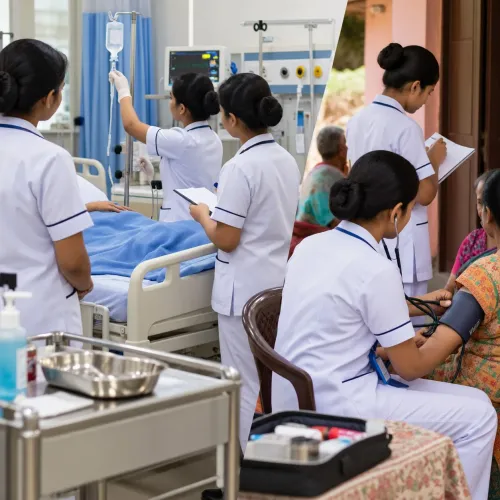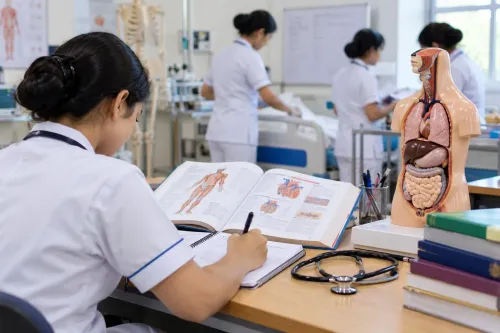


Infection control training for an OT attendant is a sequence of observable routines: clean your hands at the right moment, choose PPE for the exposure, protect sterile supplies, control movement, process waste, and report incidents. By the end, you should be able to identify the skills a course must teach, recognise unsafe shortcuts, and compare the training with nursing or sterile-processing pathways.
Key takeaways
- Apply standard precautions to every patient, regardless of diagnosis.
- Use hand hygiene and PPE according to the task and exposure risk.
- Protect sterile supplies by checking packaging, expiry dates, and contamination.
- Choose courses that assess supervised practical skills, not classroom theory alone.
Which infection-control routines are taught first?
Students first learn that standard precautions apply to every patient, whether infection is known or not. They practise hand hygiene, respiratory hygiene, safe injection support, risk-assessed personal protective equipment (PPE), and safe handling of contaminated equipment and linen.
The WHO Five Moments for hand hygiene are:
- Before touching a patient
- Before a clean or aseptic procedure
- After body-fluid exposure risk
- After touching a patient’s surroundings
- After touching a patient
| Method | What students practise | When it applies |
|---|---|---|
| Soap and water | Wet hands, apply soap, rub every surface, rinse, dry, and use the towel to avoid the tap | Hands look dirty, after toilet use, or suspected spore-forming infection |
| Alcohol-based hand rubs | Apply enough product and rub every surface until dry | Hands look clean and rapid decontamination is appropriate |
Students keep clean hands away from taps, door handles, phones, hair, and uniforms. Gloves do not replace hand hygiene. They choose gloves, masks, gowns, eye protection, head covers, and shoe covers according to anticipated exposure, then follow the facility-approved donning sequence. During removal, they handle the dirtiest surfaces first without touching skin or clothing.
Respiratory hygiene means covering coughs, using tissues or a mask as instructed, cleaning hands after respiratory secretions, and directing symptomatic patients to hospital instructions. They also learn that a needle, syringe, or injection site requires aseptic support, not casual handling.
How do students protect sterile supplies and the operating-theatre workflow?
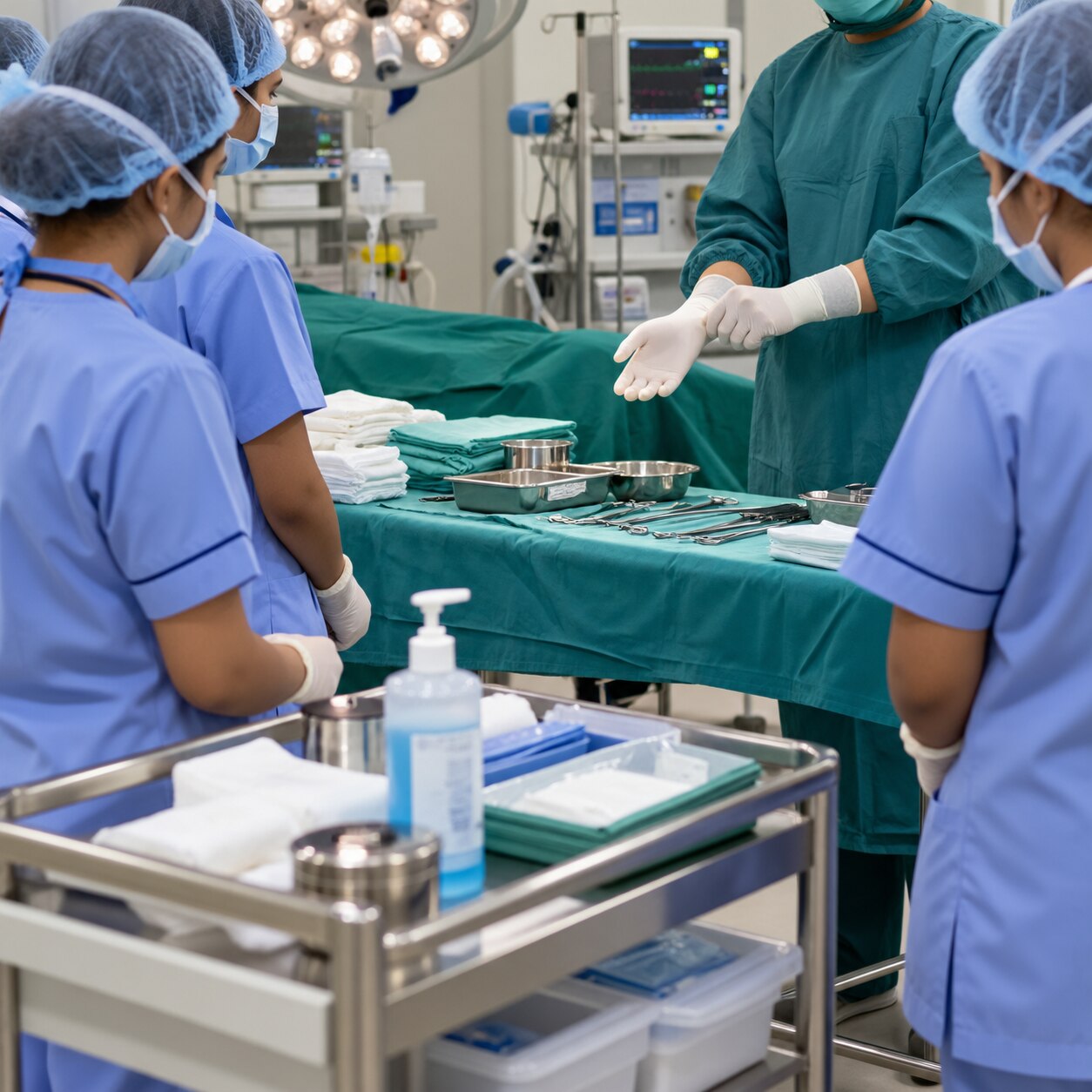
Students protect sterile supplies by identifying whether an item is sterile, clean, disinfected, or contaminated. A sterile instrument pack is ready for an aseptic procedure; a disinfected trolley has completed a defined process but is not automatically sterile; used surgical dressings are contaminated items. Treat a torn, wet, expired, or uncertain package as unsafe—never guess.
- Practise aseptic technique: keep nonsterile hands away from sterile surfaces, never reach over a sterile field, and never pass contaminated equipment across it.
- Apply operating-theatre zoning: unrestricted, semi-restricted, and restricted areas require defined attire, authorised access, controlled traffic, closed doors, and minimal movement.
- Move patients, linen, specimens, bed equipment, and used supplies from clean to dirty areas. Do not carry contaminated materials back through a clean workflow.
- Follow instrument reprocessing: point-of-use treatment, covered transport, cleaning, inspection, packaging, sterilisation or disinfection, storage, and release. Cleaning must precede disinfection or sterilisation because retained soil can shield microorganisms.
- Use Spaulding classification: critical items entering sterile tissue or the vascular system require sterilisation; semicritical items contacting mucous membranes require at least high-level disinfection; noncritical items touching intact skin require low-level disinfection.
- Check chemical indicators, required biological indicators, cycle records, and failed-load procedures. A completed steriliser cycle alone does not release a load.
This workflow protects both the patient and the next procedure. Clean hands, controlled movement, and immediate reporting of contamination matter more than speed.
How are rooms, equipment, waste, and exposures managed safely?
Between procedures, students clean operating tables, trolleys, floors, high-touch surfaces, and reusable equipment; terminal cleaning follows the last procedure. They use the hospital’s named product, dilution, application method, and contact time. Routine fogging or fumigation does not replace manual cleaning.
For blood and body-fluid spills, the procedure is:
- Restrict the area and keep people away from the spill.
- Put on PPE suited to the exposure, then remove visible material safely without splashing.
- Place contaminated material in the correct biomedical-waste container.
- Apply the disinfectant specified by the hospital protocol for the required contact time.
- Remove PPE safely, perform hand hygiene, and report contamination that could affect workflow.
Biomedical waste management covers segregation at the point of generation, labelling, closed transport, and temporary storage under the Biomedical Waste Management Rules, 2016. Training includes sharps, soiled dressings, anatomical waste, and contaminated plastics. Used needles go immediately into a closable, puncture-resistant, leak-resistant sharps container near the point of use; students never recap needles.
A needlestick injury or splash requires immediate first aid, prompt reporting, exposure documentation, and post-exposure assessment. Vaccination, occupational health checks, and follow-up complete the safety system. Contact, droplet, and airborne precautions are added only when directed by the infection-control team, not invented from personal judgement.
The attendant supports preparation, transport, cleaning, and safe workflow, but does not diagnose infection, prescribe antibiotics, release sterilised equipment independently, or replace nursing, infection-control, or sterilisation staff.
What practical errors and assessments reveal real competence?
A real infection-control assessment makes you perform each routine under observation, not recite its steps. The assessor records whether your decisions remain safe when the procedure becomes busy, interrupted, or contaminated.
1. Demonstrate hand hygiene before and after glove use, including cleaning hands when gloves were worn. Rub every surface until dry, and avoid touching a phone, tap, door handle, hair, or uniform afterward.
2. Complete PPE donning and doffing by choosing protection for the task. A surgical mask is not respiratory protection for every hazard; the required respirator, gown, gloves, and eye protection depend on exposure risk.
3. Inspect a sterile pack before opening it. Reject torn, wet, expired, or uncertain packaging instead of deciding that an unsafe item is acceptable.
4. Sort waste at its point of generation, respond to a simulated spill, and keep used instruments covered. The assessor looks for common infection-control errors such as mixing clean and dirty linen.
5. Show sterile-field awareness by avoiding reaches across the field and reporting contamination immediately. Accurate incident reporting includes what happened, which item or person was affected, and what action followed.
6. Demonstrate clean-to-dirty workflow while keeping doors closed and movement limited. Operating-room ventilation uses positive pressure and at least 15 air changes per hour, including 3 outdoor-air changes, so unnecessary traffic matters.
7. Follow instructions for skin antisepsis, antibiotic timing, clipper use when hair removal is required, and patient normothermia. Repeat practice during long procedure lists until each step remains reliable.
Learners document completed tasks and follow facility-specific standard operating procedures. Disinfectant contact time, waste-colour coding, PPE rules, ventilation controls, and equipment duties vary by hospital; local policy governs the demonstration.
How should you compare courses when infection control is your main interest?
Make the OT attendant course comparison about authority and practice, not the course title. An attendant supports theatre preparation and sterile workflow under supervision; the role does not include diagnosing infection, prescribing antibiotics, or releasing questionable sterile items.
| Pathway | Practice emphasis | Authority and career fit |
|---|---|---|
| OT attendant course | Room cleaning, equipment movement, waste segregation, theatre preparation, and supervised sterile workflow | Fits learners seeking supervised operating-theatre responsibility |
| GNM | Nursing assessment, medication administration, patient management, and broader clinical care | Provides a wider nursing role with greater clinical decision-making |
| B.Sc. Nursing | Nursing assessment, treatment support, patient management, and clinical decisions | Fits learners seeking professional nursing responsibility |
| CSSD and sterile-processing programme | Decontamination, cleaning, packaging, steriliser operation, load release, traceability, and instrument processing | Fits specialist sterile-services work rather than general theatre support |
| Healthcare assistant course | Wider bedside and daily-care support | Offers broader support work but less operating-theatre depth |
For course evaluation, ask every provider:
- Will you use an operating-theatre lab or complete a placement with documented clinical hours?
- Does training include supervised PPE practice, cleaning, disinfection, sterilisation demonstrations, biomedical-waste scenarios, and infection-control assessments?
- Who supervises students, and which tasks remain outside an attendant’s authority?
- Do instructors teach the hospital’s actual SOPs, including product contact times and waste codes, instead of generic colour charts?
For a local comparison, ask Amar Professional College of Nursing 08048059238 whether its current training provides these facilities, assessments, supervised routines, and documented hours. Choose another pathway when your career fit requires independent nursing assessment, medication authority, patient management, or specialist sterile-processing responsibility.
Frequently asked questions
Which infection-control routines are taught first in an OT attendant course?
Students begin with standard precautions, hand hygiene, respiratory hygiene, safe injection support, task-based PPE selection, and safe handling of contaminated equipment and linen.
How do students protect sterile supplies and the operating-theatre workflow?
They learn to check package integrity, expiry dates, sterility indicators, and sterile-field boundaries while maintaining a controlled movement and handover workflow.
How are operating rooms, equipment, waste, and exposures managed safely?
Training covers room cleaning sequences, equipment decontamination, segregation of biomedical waste, sharps safety, spill response, and immediate reporting after exposure incidents.
What practical errors reveal weak infection-control competence?
Common errors include touching sterile items with contaminated gloves, breaking sterile-field boundaries, skipping hand hygiene between tasks, and disposing of sharps incorrectly.
How should you compare OT attendant courses when infection control is your main interest?
Compare supervised theatre practice, skills checklists, infection-control demonstrations, assessment methods, equipment access, and the course's coverage of waste and exposure management.